Not long ago, we tested the affordable and relatively compact Vinga Gaia case, designed for microATX motherboards. This modern solution incorporates all the good features we have seen in larger representatives of the Vinga model range. And the price of $36 is quite reasonable.
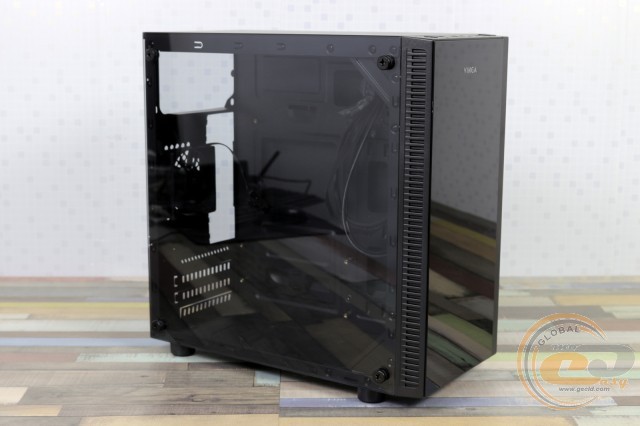
However, the manufacturer offers an even more affordable ($31) and equally trendy (at least in appearance) case - Vinga Abyss. Glass front and side panels on devices in this price category are more of an exception than a rule. And this case has them. So where did the manufacturer save money? Let's find out.
Specification
|
Model |
Vinga Abyss |
||
|
Case Size |
Mini Tower |
||
|
Supported Motherboard Form Factors |
microATX / Mini-ITX |
||
|
Color |
Black |
||
|
Internal Bays |
1 x 3.5" 2 x 2.5" |
||
|
Expansion Slots |
4 |
||
|
Maximum GPU Length (in brackets - own measurements) |
325 mm (300 mm) |
||
|
Maximum CPU Cooler Height (in brackets - own measurements) |
145 mm (149 mm) |
||
|
Ports |
1 x USB 3.0 2 x USB 2.0 2 x audio ports |
||
|
Pre-installed Fans |
On the rear panel |
1 x 80-mm |
|
|
Fan Installation Capability |
On the front panel |
2 x 120-mm |
|
|
On the rear panel |
1 x 80-mm |
||
|
Power Supply |
None |
||
|
Materials |
Front Panel |
Glass |
|
|
Chassis |
Steel thickness 0.45-0.5 mm |
||
|
Right Side Panel |
Steel thickness 0.47 mm |
||
|
Left Side Panel |
Glass thickness 3.9 mm |
||
|
Case Dimensions (in brackets – own measurements) |
325 x 170 x 350 mm (367 x 190 x 372 mm) |
||
|
Weight (own measurements) |
3.4 kg (3.4 kg) |
||
|
Manufacturer's Website |
|||
Packaging and Delivery Set
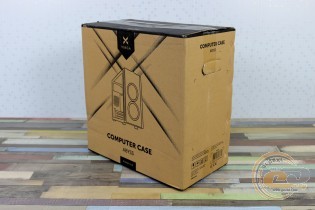
The usual monochrome box is fully synchronized with the manufacturer's website. Transportation cutouts are in place.
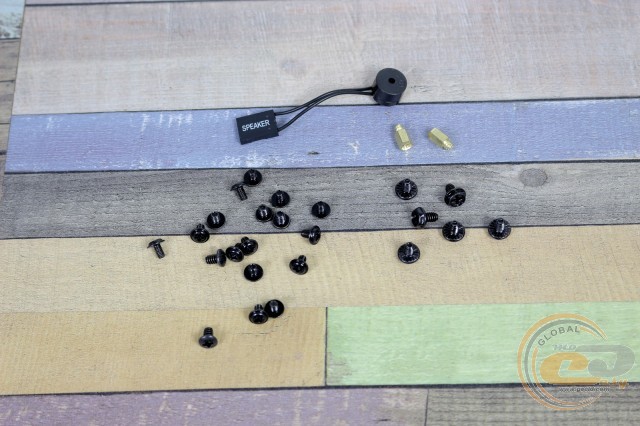
The modest package is characteristic of a $30 case. It contains only screws, stands, and a system speaker.
Appearance
Almost the entire front panel of the Vinga Abyss is represented by slightly tinted glass with the manufacturer's logo. And a bit of practical matte plastic to boot. Overall, it looks attractive and enticing.
The top edge has space for the usual ports and buttons. Among them are bright LED indicators, a reset button, one USB 3.0, a pair of USB 2.0 with audio jacks, and a power button. There are no unused plugs here, which is nice.
The panel is attached to the chassis with six clips, so it can be removed without any difficulty. Behind it, we find a couple of mounting spots for 120-mm fans. The glass practically begs for fans with LED lighting to be installed here, and cool air will enter through the holes in the plastic on the sides and bottom. There is no dust protection at all.
The rear panel is the complete opposite of the front. But that's not a problem, as it won't be looked at often. Also, it would have been nice to see something larger than an 80-mm fan here. However, the case's width of 190 mm imposes its limitations. It's good that there is a fan at all. It is powered through a PATA connector and a 30-cm cable.
There are only four expansion slots: one with a reusable cover and three with disposable ones. There is also a common clamping plate, which is fixed with one screw.
The bottom of the Vinga Abyss turned out to be as simple as possible: the top-mounted PSU eliminated the need for a bottom dust filter. The only interesting feature is the four plastic feet. Their height of 17 mm is pleasing, as cool air will be drawn in from the bottom of the front panel as well. It's also nice to see cushioning pads that protect the surface from damage.
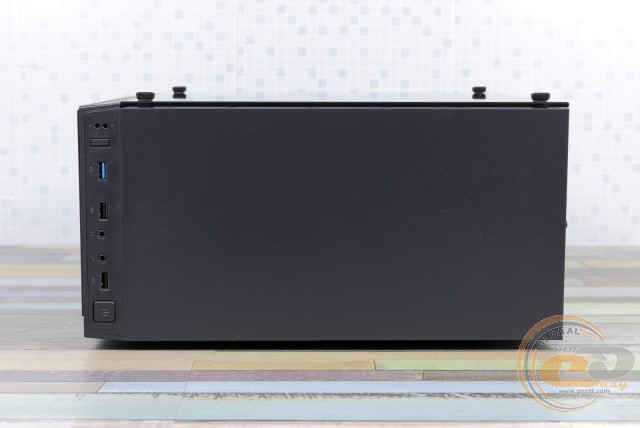
The solid top panel is fully painted with black matte paint. It is perfect for storing books, gadgets, and other items.
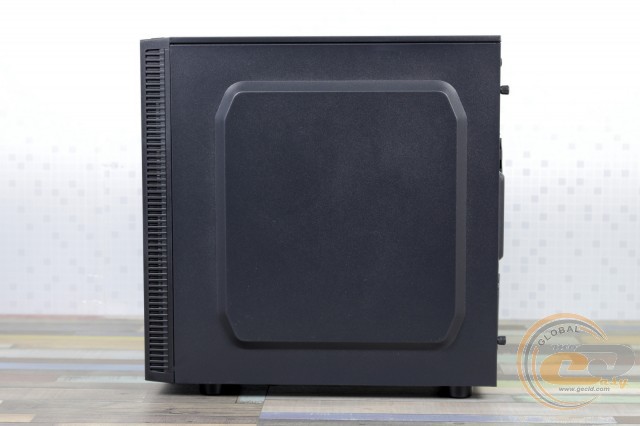
A similar coating is also on the right side, and stamping is provided to increase rigidity. And this is very good because 0.47-mm steel definitely requires additional reinforcement. Such reinforcement is also present inside along the perimeter. The mounting here is quite usual - with threaded screws at the back. There is even a notch for convenient removal.
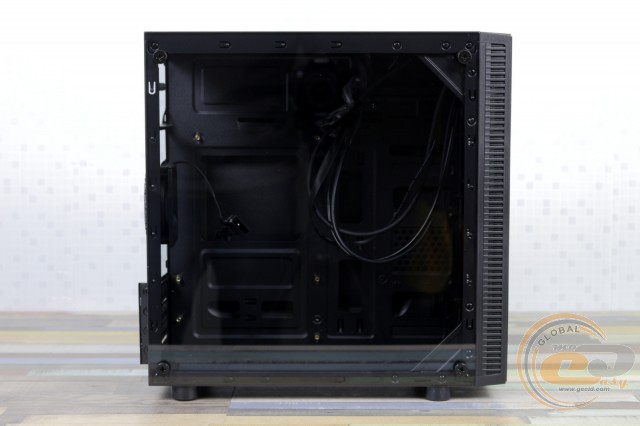
If the aforementioned Vinga Gaia case had only a small acrylic window on the left panel, the Vinga Abyss received a full-format glass with dimensions of 325 x 350 mm and a thickness of 3.9 mm. The high degree of transparency will allow you to admire the components even when the system is turned off.
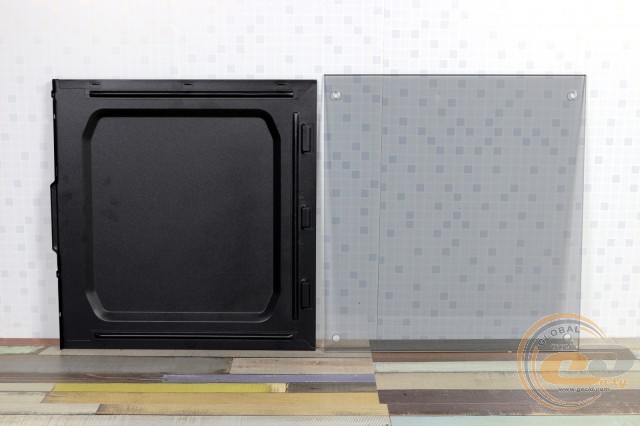
The mounting is standard for such surfaces: four screws in the same plane. Gaskets are provided at the points of contact with the chassis to protect the relatively fragile material.
Internal Structure
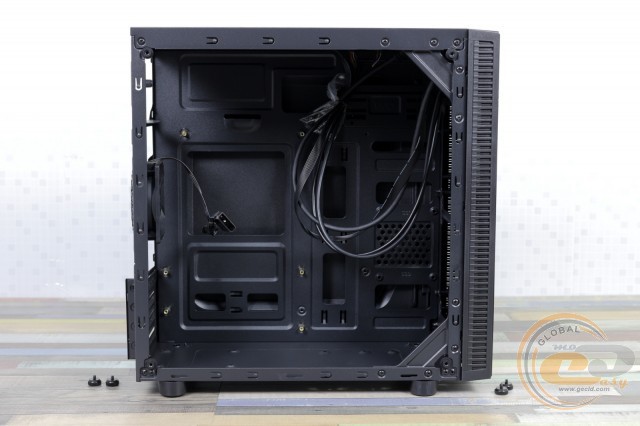
The review of the back panel has already revealed many features of the internal layout of the case. Before us is a once-common design with a top-mounted PSU, which is sometimes still found in the budget segment of devices, even from more well-known brands. For some, this fact will be an argument "against," but it will not be fundamental for everyone.
Otherwise, there are plenty of advantages: full internal painting, support for large video cards, and ample space for air circulation. But let's go in order.
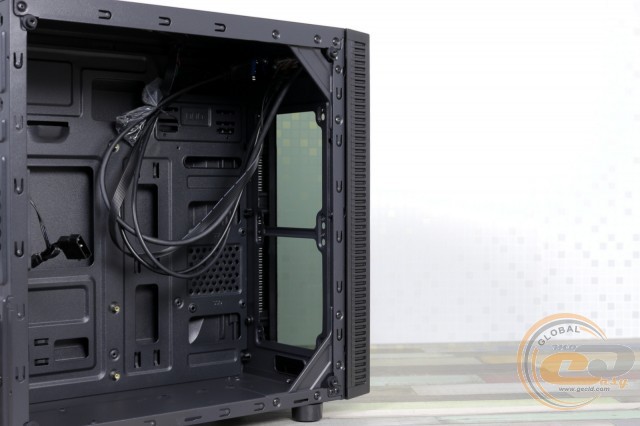
There are minimal signs of unification in the Vinga Abyss chassis, and this is pleasant. Yes, there are holes for mounting an optical drive on the tray, but the front panel configuration does not provide for such an option. Apparently, installing an AIO cooler in the front is also not anticipated. However, next to the microATX or Mini-ITX motherboard, there is room for an SSD or a compact hard drive.
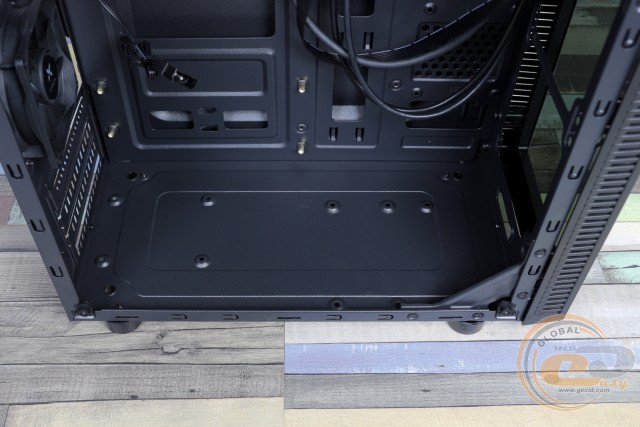
Another 2.5" and 3.5" drive can be installed at the bottom of the case - on the back and front panels, respectively, secured with the included screws from the outside. Unfortunately, both will be heated by the video card if used. Therefore, the space on the tray is more precisely defined.
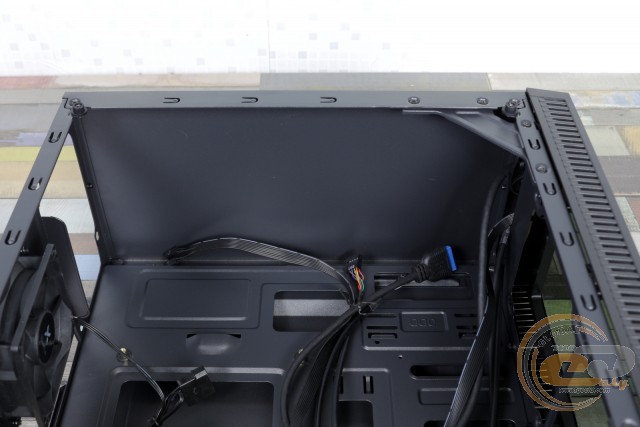
The length of the power supply is almost unlimited - even 230-mm models will easily fit. There is a platform on the back panel and another smaller one on the tray to support the device.
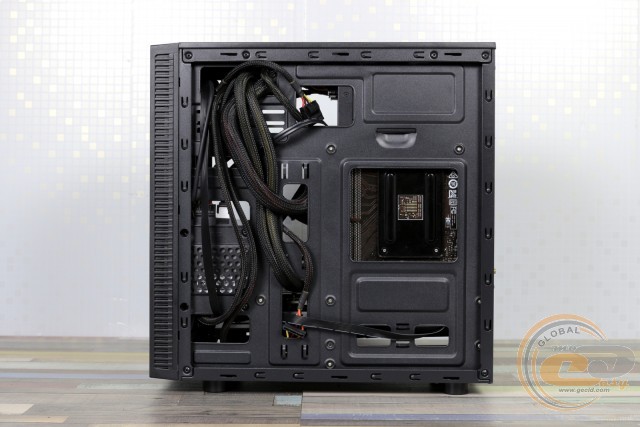
There is also space for hidden cable management in the Vinga Abyss. Although it's still not possible to hide everything completely, as the power supply is fully exposed. Nevertheless, some order can and should be established.
There is a cutout in the tray, but it may not always be usable. For example, on the AMD platform, access to the two top holes may be blocked.
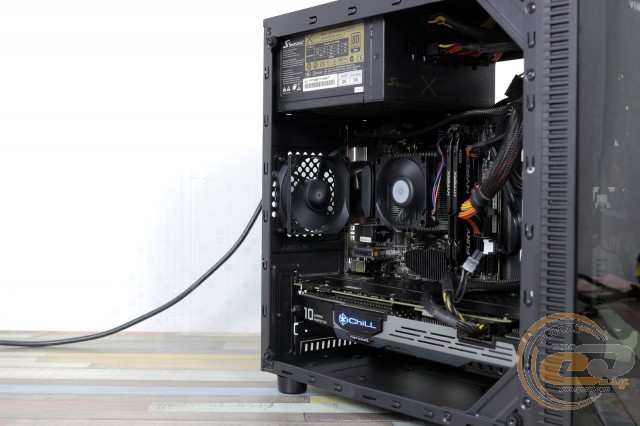
Overall, the case is ready to accommodate a CPU cooler up to 145 mm in height (we measured 149 mm), allowing even a small "tower" to be installed.
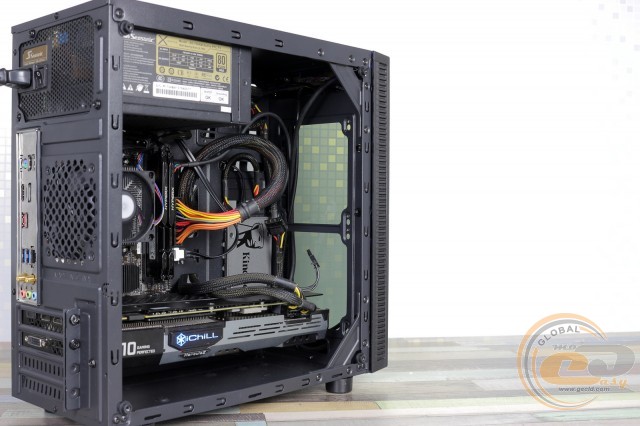
With video cards, it's even more interesting: a 3-fan 300-mm Inno3D iChill GeForce GTX 1080 X3 fit without problems, but we advise limiting to solutions of this length. Although the manufacturer specifies an allowable length of 325 mm.
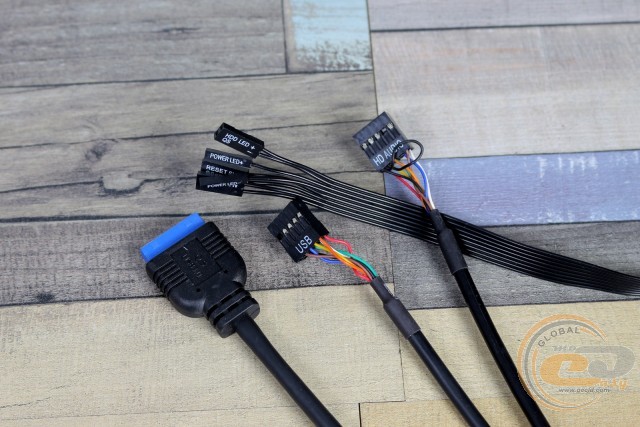
Another point regarding assembly. The cables coming from the front panel are long enough, considering the dimensions of the case itself, so there will be no problems with their connection.
|
Name |
Length, cm |
|
USB 3.0 |
50 |
|
USB 2.0 |
50 |
|
HD Audio |
50 |
|
Buttons and Indicators |
65 |
|
PATA (fan) |
30 |
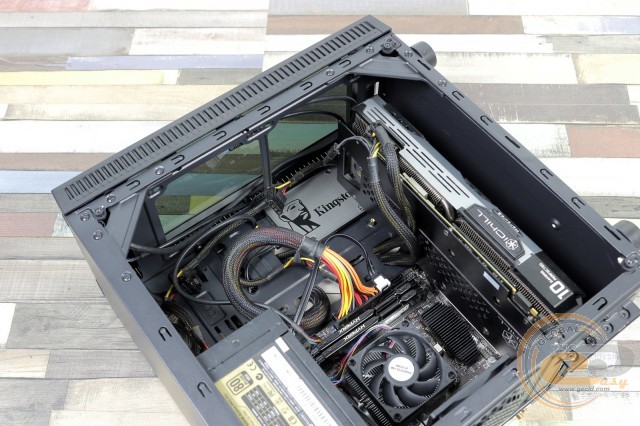
The Vinga Abyss design uses fairly thin steel with a thickness of 0.45-0.5 mm. The absence of a drive cage in the front part also negatively affected the rigidity of the case. Therefore, small brackets connecting the generously perforated front part with the solid top and bottom panels serve as a minor support.
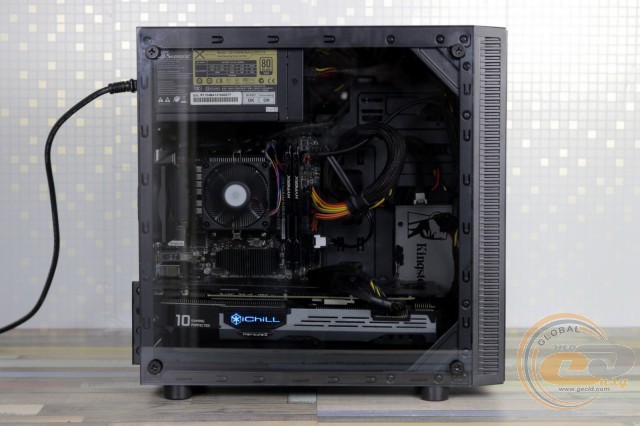
There should be no difficulties with the assembly process. Although, of course, there is a lack of space compared to more familiar Middle Tower solutions. There are also no questions about the edging, the quality of the case itself, and the painting.
The practicality of the painted surfaces is more pleasing, but the glass... Well, you understand.
Testing
|
Processor |
AMD Athlon 200GE (Socket AM4, 3.2 GHz) |
|
Cooler |
AMD (Box, 3500 RPM) |
|
Motherboard |
MSI B350I PRO AC |
|
RAM |
2 x 8 GB DDR4-2400 HyperX Fury HX424C15FBK2/16 |
|
Video Card |
Inno3D iChill GeForce GTX 1080 HerculeZ X3 |
|
SSD |
SSD Kingston SUV500/480G |
|
Power Supply |
Seasonic X-760 Gold (SS-760KM Active PFC, ATX, 760W) |
The "All System Load" chart shows the heating of components after 30 minutes of 3DMark Fire Strike in Ultra mode (4K resolution). The "System Component Burn" mode demonstrates temperatures under load with AIDA64 applications (Stress CPU and FPU) and MSI Kombustor for 15 minutes.
The Vinga Abyss case was tested with a single installed fan. At the same time, the CPU and GPU cooling systems' speed was forcibly set to 100%. The room air temperature was +25°C.
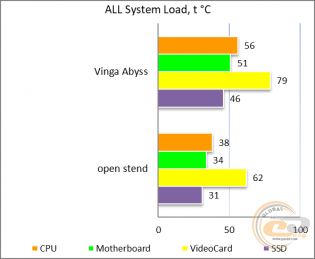
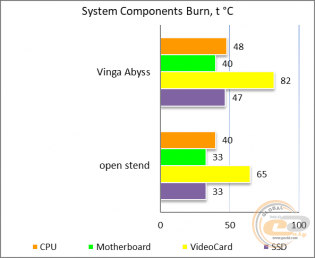
Although there are openings on the sides of the front panel for capturing cool air, there is a severe lack of fans to do so. If there is any 65-watt processor inside paired with the same GTX 1050 Ti, it will suffice. But a more powerful graphics card will be more sensitive to the limited space with a single 80-mm fan. And we would like to see the SSD cooler, as we have already placed it in a remote corner. Therefore, we recommend purchasing a powerful video adapter only in conjunction with a 120-mm fan on the front panel.
Conclusions
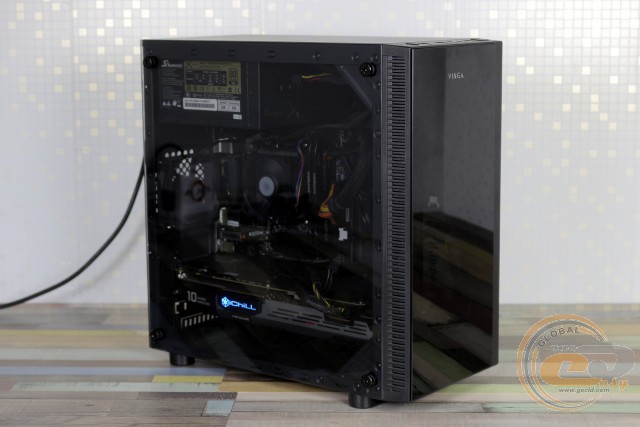
Compact cases from Vinga delight with their variety, allowing you to find a solution for every taste. For example, the previously tested Vinga Gaia will appeal to fans of modern design and good airflow, while Vinga Abyss will attract fans of glass panels. They allow you to enjoy the view of components even when the PC is turned off. And if you buy RGB fans, you can organize a real riot of colors.
Of course, the modest $31 was enough only for basic needs. We have thin metal (0.45-0.5 mm) and corresponding structural rigidity, as well as a top-mounted PSU. Since there is no rack for drives here, there is plenty of space for installing large graphics cards. But the disk subsystem will be limited to a maximum of three devices, two of which will be cooled and heated by the graphics card, if present. In this case, installing a front fan is simply mandatory, although the included 80-mm fan also contributes to cooling the internal space.
As a result, the Vinga Abyss case can boast a beautiful design and a modest price. If these points are a priority, you can safely buy it. But if you want a more thoughtful internal structure, better rigidity, and airflow, then pay attention to Vinga Gaia. There is also something to see there.
Advantages:
- modern design with glass panels on the front and left;
- support for 300-mm graphics cards, 145-mm CPU coolers, and 230-mm power supplies;
- installed 80-mm fan;
- soft feet to preserve the surface;
- hidden cable management capabilities.
Features:
- support for only one 3.5" and a pair of 2.5" drives;
- low structural rigidity;
- top-mounted PSU.
Author: Oles Pakhok
Translation: Liliya Masyuk