We have repeatedly noted that the price range from $30 to $35 is the most saturated with various computer cases under the Vinga brand. One of them is Vinga CS303B, which we will take a closer look at in this review.
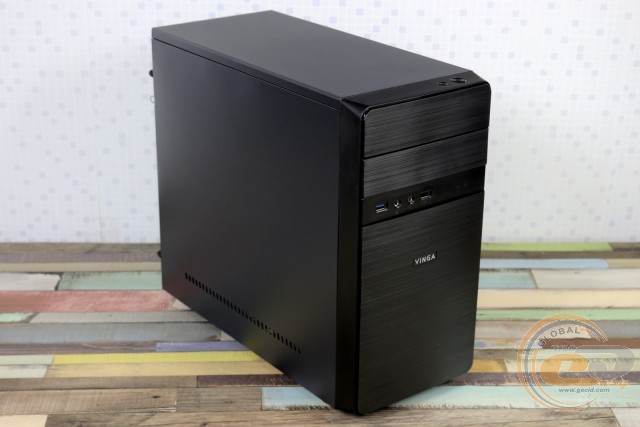
However, the new model noticeably differs from its predecessors in the lineup that we have tested before. Firstly, it is a compact Mini Tower designed for microATX and Mini-ITX boards with a maximum of four expansion slots. Secondly, it already comes with a power supply from Vinga. But how did they manage to keep such an affordable price? Let's find out.
Specification
|
Model |
Vinga CS303B |
|||
|
Case Size |
Mini Tower |
|||
|
Supported Motherboard Form Factors |
microATX / Mini-ITX |
|||
|
Color |
Black |
|||
|
Bays |
External |
1 x 5.25” |
||
|
Internal |
3 x 3.5” 2 x 2.5” |
|||
|
Expansion Card Slots |
4 |
|||
|
Maximum Graphics Card Length (in brackets - own measurements) |
320 mm (340 mm) |
|||
|
Maximum CPU Cooler Height (in brackets - own measurements) |
– (154 mm) |
|||
|
Ports |
1 x USB 3.0 1 x USB 2.0 2 x Audio Ports |
|||
|
Fan Installation Options |
Front Panel |
1 x 120-mm / 92-mm / 80-mm |
||
|
Rear Panel |
1 x 120-mm / 80-mm |
|||
|
Power Supply |
Vinga PSU-400A-F3 |
|||
|
Materials |
Front Panel |
Plastic |
||
|
Chassis |
Steel thickness 0.5 mm |
|||
|
Sides |
Steel thickness 0.55 mm |
|||
|
Case Dimensions (in brackets - own measurements) |
370 x 350 x 180 mm (365 x 415 x 182 mm) |
|||
|
Weight |
4.5 kg |
|||
|
Manufacturer's Website |
||||
Packaging and Delivery Set
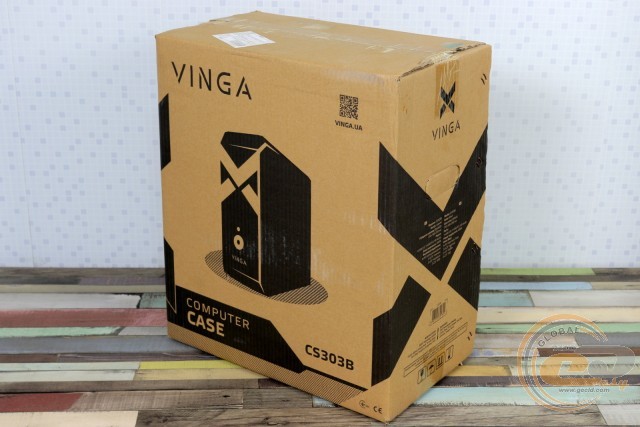
A simple cardboard box with a short specification table performs its primary function well – preserving the device during transportation.
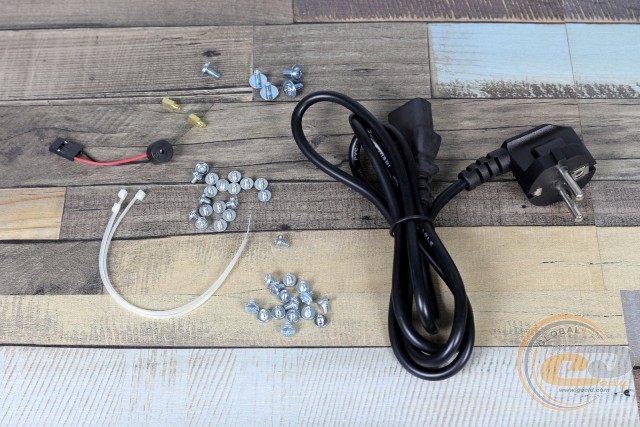
Inside the packaging, we found a number of useful components that will come in handy during assembly:
- a set of screws and standoffs for motherboard installation;
- a set of screws for securing the power supply and drives;
- a power cable;
- a system speaker;
- cable ties.
Appearance
Although the Vinga CS303B case primarily claims a role in an office system, its appearance can adorn any room. The brushed metal texture looks not only beautiful but also expensive. However, it is easy to leave fingerprints here, though just as easy to remove them.
The front panel layout allows for the installation of one 5.25-inch device, although the official website and packaging insist on the presence of two such slots. However, a single bay is sufficient for a simple modern PC. It is covered by a flip cover that opens by pressing a button on the side – a rather elegant way to hide even an old optical drive.
The usual elements of the front panel include power and reset buttons (on the top edge), a pair of LED indicators, two 3.5-mm audio ports, and one USB 3.0 and USB 2.0 each. It's nice to see at least one USB third revision interface here, and another pleasant surprise awaits us on the other side of the wire, but more on that below.
Yet, the budget approach is evident in the details: the plastic's inconsistency around the interfaces and the case corners protruding beyond the front panel. However, for such an affordable solution, this can be forgiven.
The rear panel, painted only with a primer layer, also reminds of the device's price segment. But that's okay – both it and the similarly colored chassis will hardly be seen by anyone.
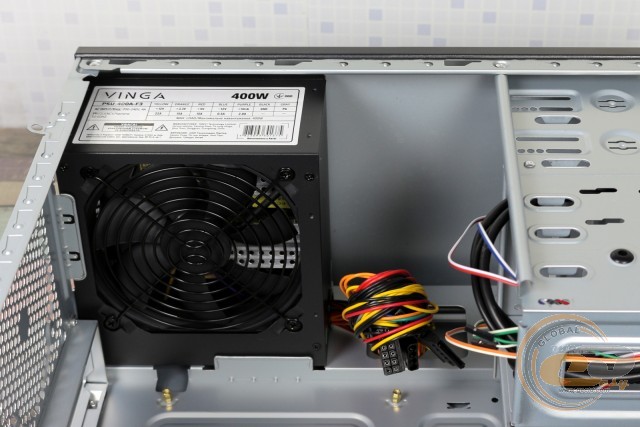
It's been a while since we tested cases with a top-mounted power supply, but that doesn't mean they are no longer available for sale. The Vinga CS303B has just such a layout. The device's width of 182 mm allows for the installation of a 120-mm fan at the back, although there are also holes for an 80-mm solution. The availability of 92-mm diameter fans was somehow not considered here, but skilled hands can compensate for this circumstance if desired.
Below are four expansion slots with one-time plugs - a common budget approach.
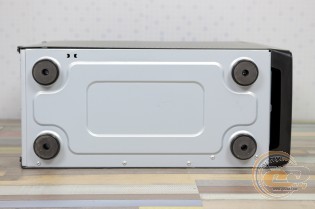
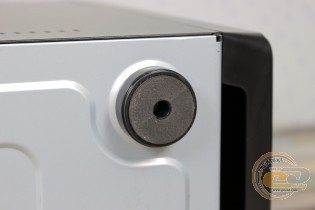
As with any other case with a top-mounted power supply, the bottom panel of the Vinga CS303B is very simple. Near the corners are round plastic feet 15 mm high with 1.4 mm rubber pads designed to protect the surface and minimize vibrations from the system unit.
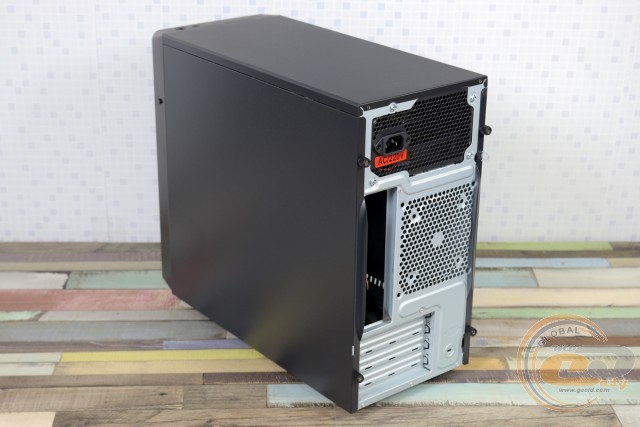
The top panel is just as unremarkable. However, it can be used to store books, document folders, and other items that take up space on the desk, floor, refrigerator, etc.
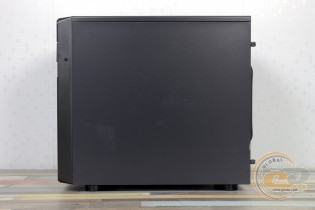
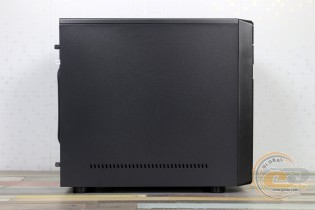
Both side panels are almost identical sheets of steel and are painted black only on the front side. The difference lies in the presence of a series of holes on the left one, designed for air circulation. Considering that the front panel is almost non-ventilated, they should still contribute to the internal microclimate of the PC.
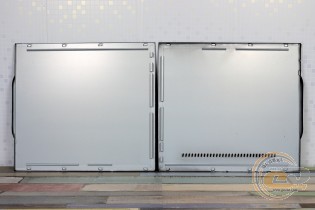
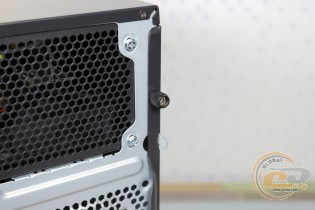
The thinness of the panels (0.55 mm) is somewhat compensated by the presence of stiffening ribs. The side panels are attached using screws with shaped heads and are removed by the usual shift to the rear.
Internal Structure
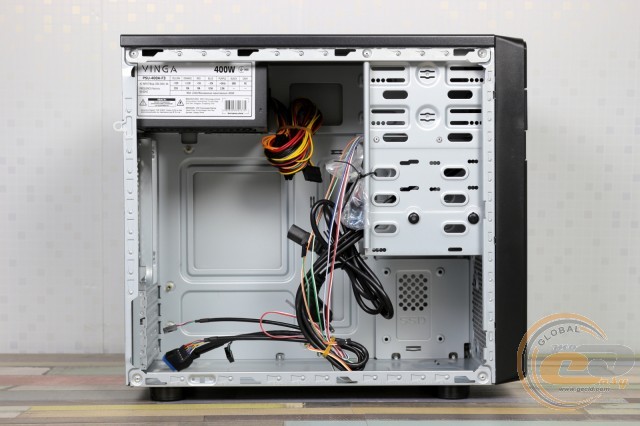
In the Vinga CS303B, you can find elements of simple office systems from a decade ago, as well as features of quite modern cases. The drive cage can be considered an anachronism, but its presence positively affects the rigidity of the structure. Moreover, it ends at the level of the expansion slots, allowing for the installation of long graphics cards.
Overall, the novelty is designed for the use of compact motherboards in microATX and Mini-ITX formats with a maximum of four expansion slots.
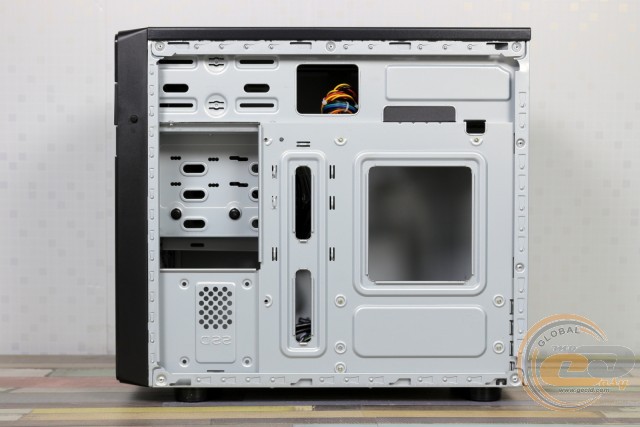
Even if you want to install a large CPU cooler inside this case (anything can happen), the cutout on the tray will allow you to perform this procedure without removing the system board. However, the proximity of the side panel only allows dreaming about hidden cable management.
The cage is designed to accommodate two 5.25-inch devices, but remember that the front panel itself will only allow the use of the lower bay. Directly below it are three mounting locations for hard drives, attached using the included screws. When using a microATX board, it is best to perform their installation and connection last for convenience. Furthermore, below are two locations for installing SSDs - a very pleasant surprise for an inexpensive case. One drive can be placed at the bottom of the cage, and the other - below it, on the tray.
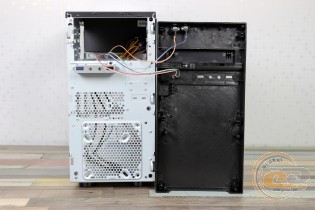
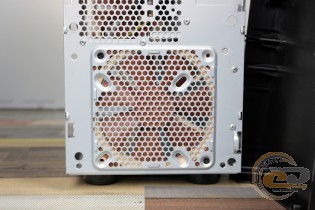
Next to the solid-state drive, you can place a 120, 92, or 80 mm fan that directs cool air inside the case. Keep in mind that the opening for its intake is only on the bottom edge of the front panel. Remember that the rear 120 mm or 80 mm fan, which expels heated air outside the case, will work with the front propeller. However, the owner of the novelty will have to purchase all these components separately.
|
Model |
Vinga PSU-400A-F3 |
|
|
Type |
ATX12V |
|
|
Maximum Power, W |
400 |
|
|
Power on +12V channel, W |
264 |
|
|
Power on +5V channel, W |
75 |
|
|
Power on +3.3V channel, W |
49.5 |
|
|
Number of +12V lines |
1 |
|
|
Outputs, A |
+3.3V |
15 |
|
+5V |
15 |
|
|
+12V |
22 |
|
|
-12V |
0.5 |
|
|
+5Vsb (standby power line) |
2 |
|
|
Input Voltage, V |
200 – 240 |
|
|
Frequency, Hz |
50 – 60 |
|
|
Input Current, A |
4 |
|
|
Efficiency, % |
Not specified |
|
|
80 PLUS Certified |
No |
|
|
Power Factor Correction Method |
Not specified |
|
|
Power Factor (PF), % |
Not specified |
|
|
PCIe Connectors |
No |
|
|
Modular |
No |
|
|
Fan Dimensions, mm |
120 x 120 x 25 |
|
|
Fan Bearing Type |
Not specified |
|
|
Protections |
OPP, OVP, SCP |
|
|
Dimensions, mm |
140 x 150 x 86 |
|
|
Manufacturer's website |
||
The Vinga PSU-400A-F3 power supply unit costs only $15 at retail. The manufacturer states that this device is intended for office-level systems, as confirmed by the label specifications. The maximum power of the source is 400W, which is very close to the total power of all power lines (404.5W). As for the most demanded +12V rail, its power is 264W, which is only 66% of the maximum value. Considering this, we also recommend using this source exclusively in a system without a discrete video adapter or with an entry-level solution that does not require a PCIe power cable connection. Moreover, there are only four additional connectors: a pair of SATA and PATA.
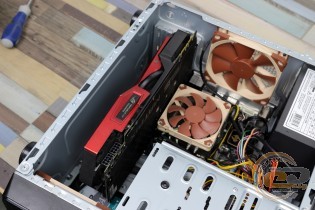
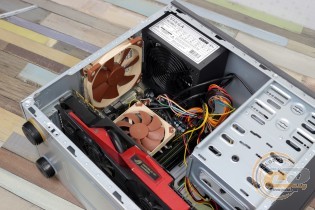
Finally, we come to the assembly process. In similar budget cases, difficulties may arise due to limited space, exacerbated by the presence of a non-removable stand, as well as due to low-quality finishing. All of this is present in the Vinga CS303B. While the first issue simply requires more time and patience, the second also necessitates stocking up on iodine, bandages, and plasters. On the positive side, we note the good fit of parts, absence of gaps, and vibrations during operation.
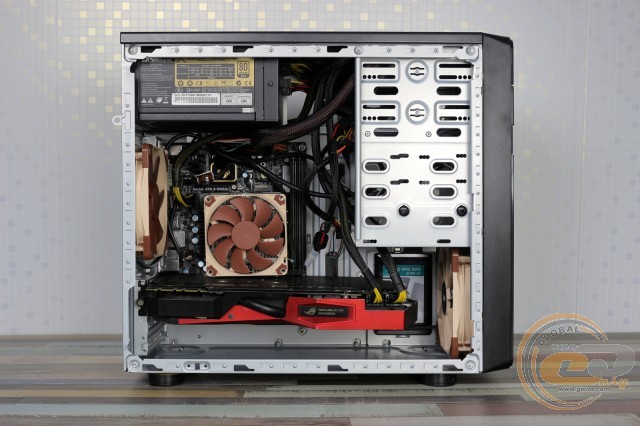
Regarding component compatibility, according to our measurements, the length of the graphics card can reach up to 340 mm. However, note that a powerful model is unlikely to cool well here, while an energy-efficient video adapter will do just fine. Moreover, there is enough space for a 154-mm tower cooler if needed.
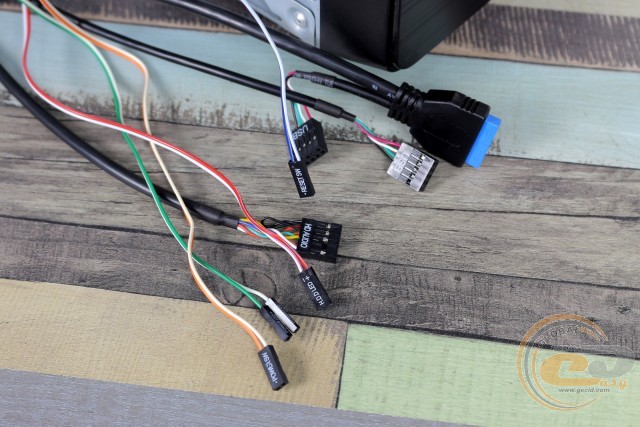
The cables from the front panel are of sufficient length. A pleasant bonus is the dual USB 3.0 interface socket, which allows using the connector as USB 2.0 if such is absent on the motherboard.
|
Name |
Length, cm |
|
USB 3.0 + USB 2.0 |
55 |
|
USB 2.0 |
55 |
|
HD Audio |
55 |
|
Buttons and indicators |
65 |
Testing
|
Processor |
Intel Core i7-4770K (Socket LGA1150, 3.5 GHz, L3 8 MB) |
|
Cooler |
Noctua NH-L9x65 (with L.N.A.) |
|
Motherboard |
ECS Z97I-DRONE (Mini-ITX, Socket LGA1150) |
|
RAM |
2 x 4 GB DDR3-2400 TwinMOS TwiSTER 9DHCGN4B-HAWP |
|
Graphics card |
ASUS GeForce GTX 980 MATRIX PLATINUM 4GB GDDR5 |
|
SSD |
SSD KINGMAX SME35 Xvalue |
|
Power supply |
Seasonic X-560 Gold (SS-560KM Active PFC, ATX, 560W) |
|
Thermal paste |
Noctua NT-H1 |
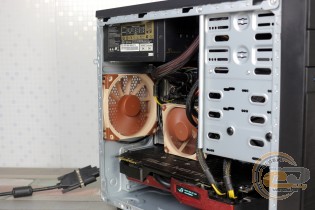
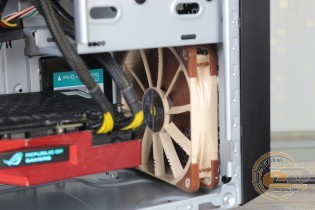
Since we are testing a non-office system with a powerful discrete graphics card, a pair of Noctua NF-F12 PWM fans were installed inside the Vinga CS303B for intake and exhaust (1500 RPM), and the power supply was replaced with a test Seasonic X-560 Gold.
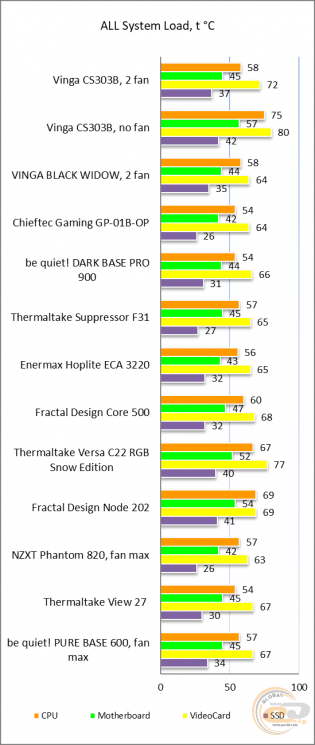
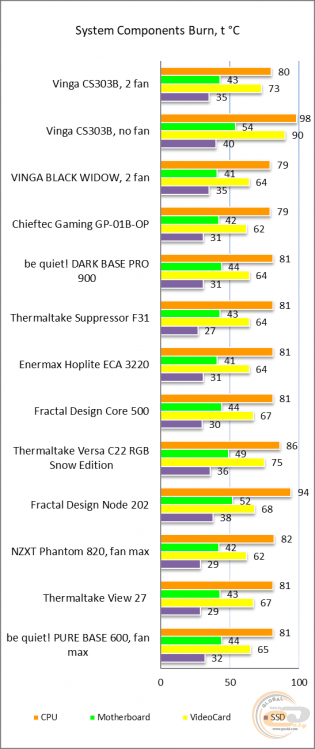
The "All System Load" chart shows component heating after 30 minutes of 3DMark Fire Strike in Ultra mode (4K resolution). The "System Component Burn" mode demonstrates temperatures under load with AIDA64 (Stress CPU and FPU) and MSI Kombustor applications for 15 minutes.
Of course, it is unlikely that anyone would assemble such a powerful system based on the Vinga CS303B case. However, we were very curious to find out how the novelty would behave in such a case - with and without fans. Completely without propellers, our processor heated up to 98°C, and with them, its temperature did not exceed 75°C. Despite the solid front panel, the fans immediately made themselves known with a noticeable reduction in processor and graphics card temperatures, so owners of discrete graphics should definitely stock up on at least a rear propeller. In this mode, the novelty does not lag so noticeably behind larger Middle Tower cases that we have had before, although there is still some increased heating of the graphics card.
Conclusions
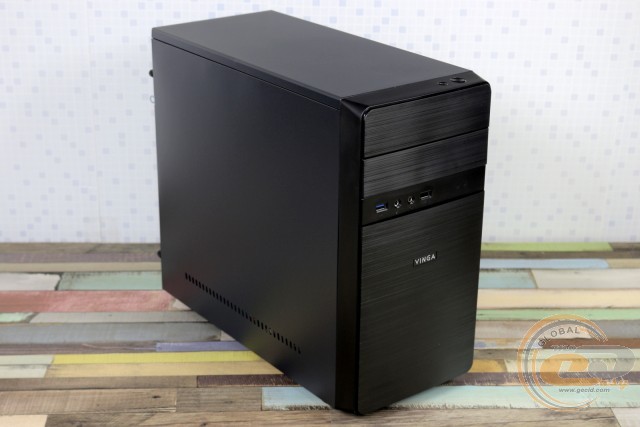
For approximately $30-35, you can buy a basic power supply unit or a modern Middle Tower case or... the Vinga CS303B case with a pre-installed power supply. But is such double savings justified?
For assembling an office or simple home system, the novelty is quite suitable. Moreover, many will even appreciate such a decoration for the workspace. Inside the compact case, a microATX or Mini-ITX motherboard, an optical drive, up to three 3.5" and a pair of 2.5" drives can fit. The number of drives will generally be limited by the power supply capabilities – don't forget about the presence of only four connectors for connecting peripherals. A video card can also be installed, and quite a long one at that. However, in this case, you will need to use a more powerful power source and additionally take care of ventilation, which will negate all savings.
In conclusion, we recommend considering the Vinga CS303B as a candidate for purchase for anyone looking to build a simple computer with a minimum of drives and no need for upgrades in the next few years. Everyone else is advised to dig into their wallet in search of funds for significantly more expensive components.
Advantages:
- elegant design with a brushed metal finish;
- ability to install one 5.25" device, three 3.5" and a pair of 2.5" drives;
- support for 320-mm video cards and 154-mm CPU coolers;
- ability to mount a pair of fans with a diameter of up to 120 mm;
- USB 3.0 port on the front panel with an additional header for connecting to a USB 2.0 connector.
Features:
- complete absence of pre-installed fans;
- the included PSU will be insufficient for installing a video card with additional power.
Disadvantages:
- during assembly, you can cut yourself on unprocessed edges.
Author: Oles Paholok
Translation: Yuriy Koval
We express our gratitude to the companies ASUS, Intel, Noctua, Sea Sonic Electronics, and TwinMOS Technologies for providing equipment for the test bench.